

Have you ever sprayed a perfume in the store and wondered why it filled the whole aisle within seconds? That reaction is projection at work. Understanding what is projection in perfume helps you choose scents that suit your personality, workplace, and daily routine – instead of guessing blindly every time you shop.
Projection is one of the most talked-about yet misunderstood concepts in fragrance. Many people confuse it with longevity or sillage; however, these three terms actually describe different behaviours. This guide breaks it all down in simple language, so you never feel lost in perfume jargon again.
What Is Projection in Perfume?
In simple terms, projection refers to how far a fragrance radiates outward from your skin into the surrounding air while you stand still. It is essentially your personal “scent bubble.”
A perfume with strong projection can be smelled by someone standing several feet away. On the other hand, a perfume with intimate projection stays close to your skin, and people need to lean in to notice it.
Therefore, projection determines how noticeable you are in a room. It is not about how long the scent lasts; it is about how far it travels. This distinction matters because many buyers mistakenly assume a “strong” perfume automatically lasts longer, which is not always true.
Why Projection Matters When Choosing a Perfume
Projection shapes how people experience your presence before they even see you. Consequently, picking the right projection level for the right setting is essential.

- A perfume with loud projection works well for parties, weddings, and evening events.
- A perfume with intimate projection suits offices, hospitals, or shared workspaces.
- The wrong choice can either make you invisible or overwhelming, depending on the setting.
If you’re new to layering scent correctly, it helps to first understand how to apply perfume the right way, since application technique directly influences how far a fragrance projects.
Projection vs Sillage vs Longevity: Clearing the Confusion
These three words often get used interchangeably, but they mean very different things.
Projection is about distance – how far the scent travels from your skin while you’re standing still.
Sillage is about the trail – the invisible cloud of fragrance that lingers in the air after you walk past someone. Think of it as the “wake” a boat leaves behind in water.
Longevity, meanwhile, is about time – how many hours the fragrance stays detectable on your skin before it fades.
In addition, a perfume can have low projection but excellent longevity. It might sit quietly on your skin for ten hours without ever filling the room. Similarly, a perfume can project loudly for the first hour and then fade quickly once the top notes evaporate.
Ultimately, no single term explains the full picture. You need to understand how projection, sillage, and longevity work together to judge a fragrance fairly.
What Determines a Perfume’s Projection?
Several factors influence how far a fragrance travels once it leaves the bottle. Understanding these helps you predict how a perfume will behave before you even buy it.
1. Fragrance Concentration
Perfume oil concentration plays the biggest role in projection strength. Eau de Parfum and Extrait de Parfum contain higher oil percentages, so they naturally project further than lighter Eau de Toilette or Cologne formulas.
2. Ingredient Volatility
Some ingredients evaporate quickly and push scent molecules into the air fast. Citrus and light florals, for example, create a bright initial burst of projection. If you enjoy fresh, energetic openings, you might like exploring the best citrus perfume for him in India, which showcases how citrus notes create an immediate, lively throw.
3. Fixatives and Base Notes
Fixatives are ingredients that slow down evaporation and stabilize the fragrance structure. They help control how projection behaves over time, preventing a scent from fading too quickly or projecting unevenly.
Heavy fixatives like musk, amber, and resins anchor lighter notes to the skin. For instance, choco musk perfume blends rely on musk as a fixative to maintain steady, warm projection throughout the day rather than a sharp initial burst followed by nothing.
4. Skin Type and Body Chemistry
Oily skin holds fragrance molecules longer, which can enhance both projection and longevity. Dry skin, however, absorbs scent faster, often causing quicker fade-out. Moisturizing before application can therefore improve how well a perfume projects.
5. Environmental Conditions
Heat and humidity accelerate evaporation, which increases projection temporarily. Cold, dry weather does the opposite, keeping fragrance molecules closer to the skin. This is why the same bottle can smell louder in summer and quieter in winter.
Types of Projection Explained
Perfume projection generally falls into a few recognizable categories. Knowing these helps you communicate what you want when shopping or reading reviews.
- Skin Scent: Barely noticeable beyond your own skin; only someone very close can detect it.
- Intimate Projection: Detectable within an arm’s length, roughly one to two feet.
- Moderate Projection: Fills a small personal space, noticeable by people nearby without being overpowering.
- Strong/Loud Projection: Radiates several feet, often filling an entire room within moments.
For example, classic bold fragrances like Old Spice perfume are known for confident, room-filling projection, making them popular for those who want a noticeable presence.
How to Test a Perfume’s Projection Before Buying
Never judge projection based on a quick sniff of the bottle cap. Instead, spray it directly onto your skin and let it settle for a few minutes.
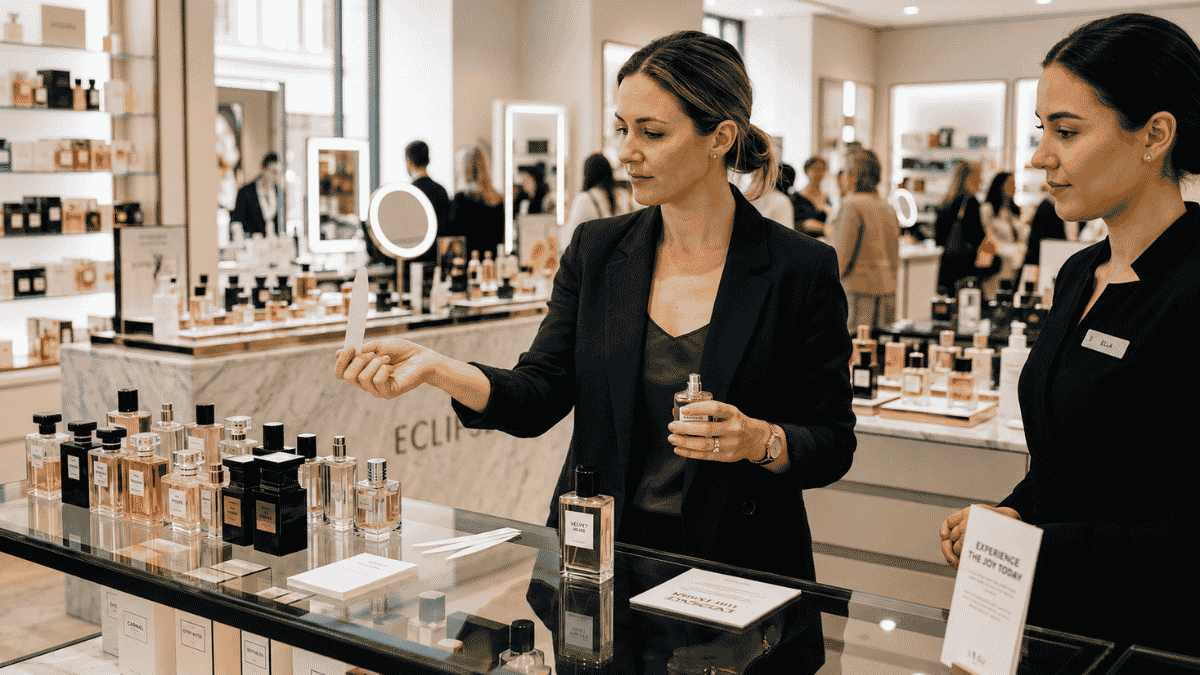
Walk around, move your arms, and let the fragrance interact with your body heat. Ask a friend to step back a few feet and tell you when they can no longer smell it. This gives you a realistic sense of how the scent will behave in real life.
It also helps to understand how testing on paper differs from skin. If you’re curious about accuracy, this guide on how long does perfume last on paper explains why paper strips often mislead buyers about true projection and longevity.
Projection Preferences by Occasion
Choosing projection strength isn’t just about personal taste; it’s about reading the room. Here’s a simple breakdown:
- Office or Classroom: Choose intimate to moderate projection. Strong scents can distract others in enclosed spaces.
- Dates or Dinners: Moderate projection works best, allowing your presence to feel warm without being overwhelming.
- Weddings or Parties: Strong projection helps you stand out and leaves a memorable impression as you move through the crowd.
- Gym or Outdoor Activities: Light, fresh scents with lower projection are ideal since heavy fragrances can clash with sweat and heat.
If you prefer something soft yet noticeable for daily wear, a scent like body mist vanilla perfume offers gentle, comforting projection perfect for casual settings.
Can You Increase a Perfume’s Projection?
Yes, projection can often be boosted with a few simple techniques.
- Apply perfume to pulse points like wrists, neck, and behind the ears, where body heat helps diffuse the scent.
- Layer with matching body lotion or shower gel to build a stronger scent foundation.
- Avoid rubbing wrists together after spraying, since friction breaks down fragrance molecules and weakens projection.
- Spray directly onto skin rather than clothing for a more natural, evolving throw.
However, more spray does not always mean more projection. Over-application can overwhelm rather than enhance, so moderation matters just as much as technique.
Common Myths About Projection
There’s a lot of misinformation floating around about how projection actually works. Let’s clear up a few common misunderstandings.
Myth 1: Expensive perfumes always have strong projection. This isn’t true. Price often reflects rare ingredients or brand value, not necessarily how far a scent travels.
Myth 2: Strong projection means better quality. Not necessarily. A well-blended perfume with moderate projection can be far more sophisticated than an overpowering one.
Myth 3: Projection and longevity are the same thing. As discussed earlier, they measure completely different qualities. A perfume can project weakly yet last on skin for many hours.
Myth 4: Natural perfumes never project well. This depends entirely on formulation. In fact, if you enjoy experimenting, learning how to make perfume at home shows how thoughtful ingredient pairing can create impressive projection even in DIY blends.
Choosing a Signature Scent Based on Projection
Finding your signature fragrance means matching projection to your lifestyle, not just chasing trends. If you love vanilla-forward, cozy scents, something like Wottagirl perfume vanilla offers warm, approachable projection suited for everyday confidence.
Ultimately, the goal is intentional choice. Instead of picking a bottle because it smelled strong in-store, consider where you’ll wear it, how long you need it to last, and how noticeable you want to be.
Conclusion
So, what is projection in perfume? It’s the invisible bubble of scent radiating from your skin, shaped by concentration, ingredients, skin type, and environment. Once you understand projection clearly, shopping for fragrance becomes far less confusing and much more intentional.
Instead of guessing, you can now match projection strength to your lifestyle – whether that’s a quiet office day or a loud, memorable evening out. Ultimately, the right projection doesn’t just make you smell good; it helps you show up exactly the way you intend to.
FAQs
Projection refers to how far a fragrance radiates from your skin into the surrounding air while you remain still.
No. Projection measures distance from your body, while sillage refers to the scent trail left behind as you move.
This usually happens because top notes are highly volatile and evaporate fast, reducing projection once they disappear.
Slightly, but only temporarily. Overall projection depends more on formulation and fixatives than on quantity applied.
Extrait de Parfum and Eau de Parfum generally project more than Eau de Toilette due to higher oil concentration.